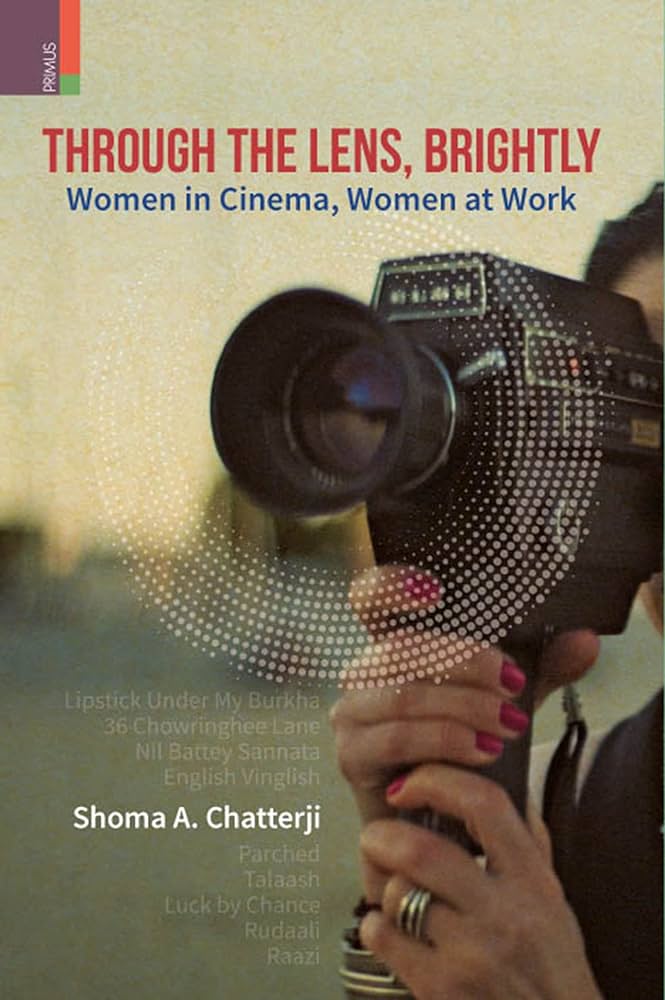
Through the Lens, Brightly: Women in Cinema, Womenat Work is National Award- winning writer Shoma A. Chatterji’s latest offering on women behind the lens. The contents page of the book can be a wee bit misleading because at first glance you might feel the writer has picked up films that we have already watched and re-watched, by women directors we are largely familiar with. But when it’s a book by Chatterji, you can expect the unexpected. What could have been a run-of-the-mill discourse has turned out to be an eye opener. It’s a highly entertaining and inspiring read. Peppered with interesting anecdotes, unknown facts and the author’s personal views, the book very intelligently steers clear from becoming an academic read. At the same time, it is a gem in the hands of students and researchers doing women’s studies, aspiring filmmakers, film scholars and students of film studies.
At the beginning of the book, Chatterji points out that women were mostly part of the film industry the world over because they brought the glamour quotient to the screen and having the acting chops wasn’t a necessity. Post WWI Hollywood saw the emergence of Dorothy Arzner, the first woman who wore the director’s cap. At almost the same time, India was also witnessing a similar change.
Cover of Through the Lens, Brightly: Women in Cinema, Women at Work by Shoma A. Chatterji
The first women directors in India
The book takes off from the fascinating perspective of how the first few Indian women took up their place behind the camera, making an unusual career choice in a male-dominated profession and making their presence felt.
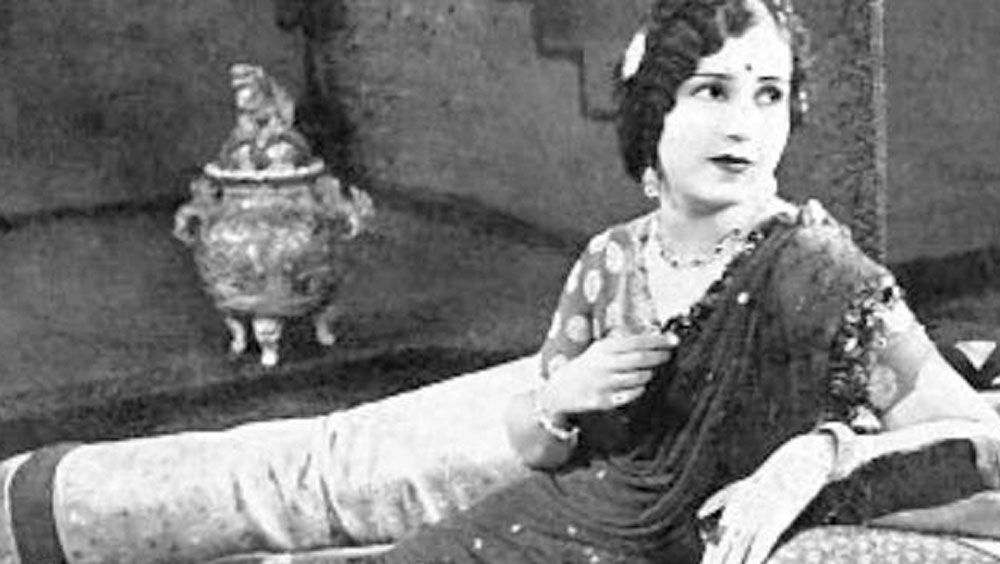
As Chatterji writes, the history of Indian women directing films dates back to the silent era. Way back in 1926, it was Fatma Begum who started her own company Fatma Films and made six films; some of the popular ones being Bulbul-E-Paristan, which first treaded the world of fantasy, Heer Ranjha and Shakuntala. She belonged to Urdu theatre and had worked with noted filmmakers Ardeshir Irani and Nanubhai Desai. Her daughter actress Zubeida was the heroine of the first talkie Alam Ara.
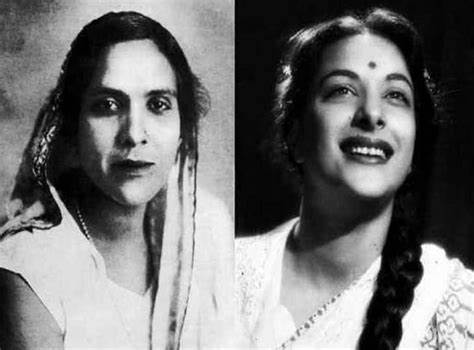
If Fatma paved the way for women to step behind the camera, superstar Nargis’ mom Jaddanbai was another ambitious lady who started the Sangeet Film Company in 1936 and directed films like Hridaya Manthan and Madam Fashion. In fact, at the age of six, Nargis made her acting debut in the film Talash-e- Haq where Jaddanbai was the heroine. Chatterji has added details about the fascinating life of Jaddanbai, the social scenario in the film industry at that time as it evolved into a respectable profession for women and how Jaddanbai, the grandmother of Sanjay Dutt, understood the opportunities the film industry in Bombay offered even in its nascent state and built on it using her prowess in acting, music and directing.
Jaddanbai, the grandmother of Sanjay Dutt, understood the opportunities the film industry in Bombay offered even in its nascent state and built on it using her prowess in acting, music and directing.
Jaddanbai and daughter Nargis
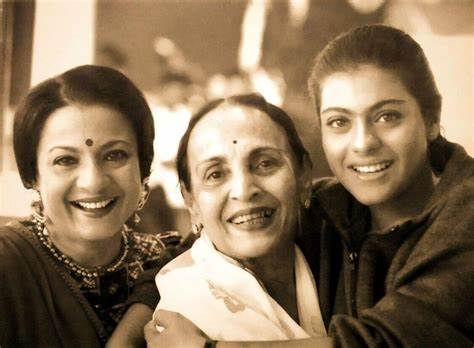
Shobhna Samarth started her career as an actress in Marathi films but she went into direction and production and eventually launched daughter Nutan as the lead in her directorial Hamari Beti and Tanuja in Chhabili.
In Bengal, noted actress Arundhati Devi received the Certificate of Merit at the National Awards in 1967 for her film Chhuti where, apart from direction, she had done the script and music. She also directed the children’s film Padi Pishir Bormi Baksha and produced Bicharak in 1959 that has stunning performances by her and Uttam Kumar.
Actress Manju De made her directorial debut with the comedy Swargo Hotey Biday in 1954 and then she directed the hugely popular Byomkesh story Sajarur Kanta (1974) which was a runaway hit.
South Indian actresses Bhanumathi, Lakshmi, Kommareddy Savitri also tried their hands at direction and succeeded.
Shobhna Samarth with daughter Tanuja (left) and granddaughter Kajol (right)
The change in the narrative
Ray focused on a working woman in Mahanagar
These early women directors had undertaken an uphill task in a male-dominated industry where the storytelling, distribution, pumping in the moolah into films, were all perceived from a man’s perspective. That’s why the heroine on screen had to be either the victim or the good girl, or the vamp placed solely for voyeuristic pleasure, bestowed with all vices. Films were made in formulas that worked again and again so the trap was inescapable.
It was men like Satyajit Ray with his focus on a working woman in Mahanagar, Vijay Anand with Rosie’s atypical character of wife, lover, dancer in Guide or Guru Dutt through Chhoti Bahu’s character in Sahib,Biwi Aur Ghulam, challenged stereotypes. But interestingly, when women started directing films in India, it wasn’t with a hunger to challenge stereotypes but the perspective that they brought to the silver screen was fresh and different. From delving into fantasy to children’s films to detective stories to social drama, they told their stories in a different way and almost always, the objectification of women, that was so far the norm, was totally missing.
It was men like Satyajit Ray with his focus on a working woman in Mahanagar, Vijay Anand with Rosie’s atypical character of wife, lover, dancer in Guide or Guru Dutt through Chhoti Bahu’s character in Sahib,Biwi Aur Ghulam, challenged stereotypes.
Women directors of the 80s
If we are talking of emergence of women directors in the 80s, as Chatterjee rightly points out, we cannot help but take off with Aparna Sen and her path-breaking film 36 Chowringhee Lane. The actress, by stepping behind the camera and by staying behind it for four decades, has been an inspiration to many women.
While later in the book Chatterji takes a nuanced look at Aparna Sen’s debut film that was initially a dud at the box office and later attained cult status, redefining storytelling in Indian cinema, in the initial part the author talks about women directors who made their presence felt in the 80s.
She touches upon Kalpana Lajmi, the niece of Guru Dutt and cousin of Shyam Benegal, who started directing her own films after working with her cousin for 10 years. Other noted directors she talks about are Vijaya Mehta, who was a well-known theatre personality and Sai Paranjpayee who became a household name with her film Chashme Baddoor. Chatterji has detailed their work, their successes, failures and the direction they gave to Indian cinema.
Aparna Sen directing Jennifer Kapoor and Dhritiman Chatterjee in 36 Chowringhee Lane
Women moving forward behind the lens
Chatterji mentions that the only thing that was common among the women directors of the 80s was the fact that they bonded through strong storylines, were versatile and had a fresh voice and their films had beautiful music.
As the writer shares interesting anecdotes about each lady director, about their ambitions and struggles, we move into the 90s when we have women who are more focused and sorted. She mentions Odiya director Bijoya Jena whose directorial debut Tara (1992) got the National Award for the Best Odiya Film. Some other noteworthy names are Gopi Desai, Prema Karanth, Satarupa Sanyal, Sumitra Bhave and Aruna Raje whose latest film Firebrand was produced by Priyanka Chopra for OTT.
And then there were the “others” like Mira Nair, Deepa Mehta, Gurinder Chadha and Pamela Rooks. They are considered the “outsiders” because they did not supposedly belong to Indian film industry and their crew comprised technicians from East and West, but the author points out that they are as much part of this milieu because they have gone ahead and challenged stereotypes and told very strong Indian stories. Mehta’s Fire, Nair’s Namesake, Chadha’s Bend It Like Beckham haveattained cult status.
Coming to the present
Among the present crop of women directors, the author mentions Reema Kagti who made her debut with the refreshing Honeymoon Travels Pvt Ltd, Meghna Gulzar’s films Raazi and Talvar, Leena Yadav’s Parched, and Zoya Akhtar and Farah Khan, both of whom have stuck to mainstream films and neither makes feminist films nor off-beat ones. Nandita Das’ Manto, Konkona Sen Sharma’s Death in the Gunj and Kiran Rao’s Dhobi Ghat are a few films that the author mentions as commendable productions.
In a very interesting section “Ladies Behind the Scenes”, Chatterji elucidates that a study in Hollywood has shown that women in crew positions only formed 22.6 % of people behind the camera. The story in India is no different, although it’s changing gradually.
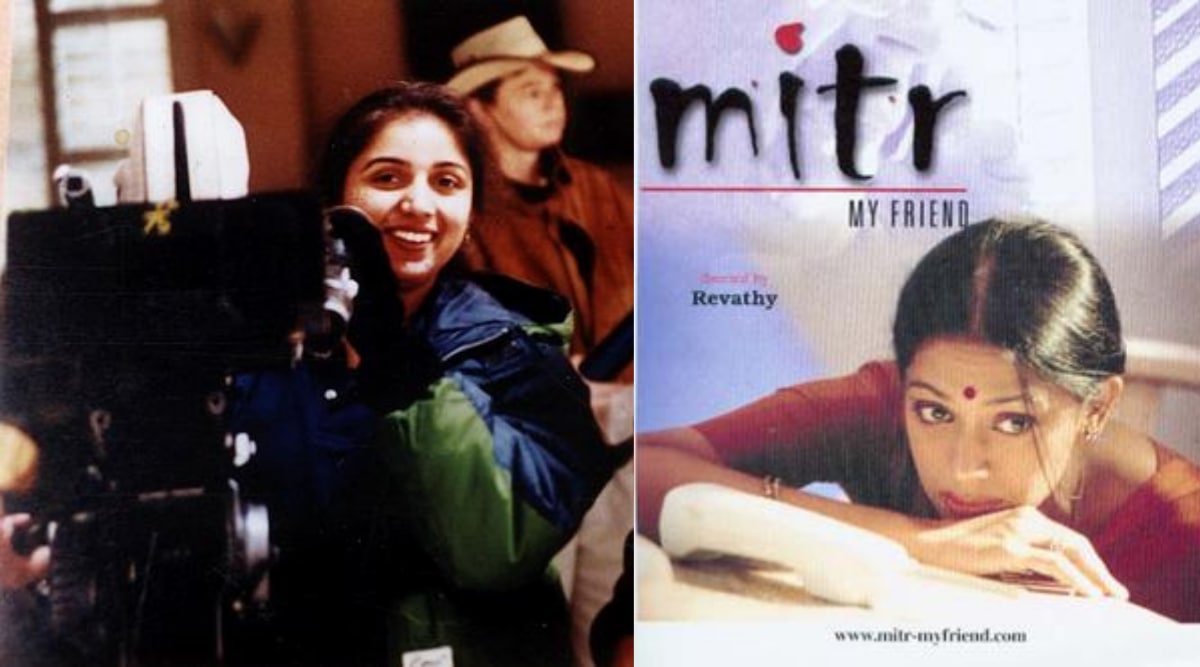
Way back in 2002, Revathi’s film Mitr, My Friend had an all-women crew and it clinched a number of awards at the National Awards. Anu Menon’s 2015 film Waiting also had an all-women crew as did Priya Beliappa’s Kannada film Ring Road in 2014. The author has given more instances in the book saying it’s rare, but it’s happening.
Way back in 2002, Revathi’s film Mitr, My Friend had an all-women crew
Revathi directing her film. (Right) Shobana in a still from Mitr, My Friend
The films in focus
In this book, Chatterji has mainly focused on how working women have been depicted in films made by women. In Aparna Sen’s 36 Chowringhee Lane, Violet Stoneham is a teacher, in Kalpana Lajmi’s Rudaali, the protagonist tries to be a part of a fading profession of lamenting women, in Leena Yadav’s Parched, the characters are crafts women and there is a travelling dancer who moonlights as a sex worker, Gauri Shinde’s English Vinglish focuses on the entrepreneur, Zoya Akhtar’s Luck By Chance has the actress as a working woman, Reema Kagti’s Talaash is about a sex worker, Ashwini Iyer Tiwari’s Nil Battey Sannata has a multi-tasking domestic maid, Alankrita Shrivastava’s Lipstick Under My Burkha covers roles like a landlady, a beauty salon worker and a nude model and Meghna Gulzar’s Raazi looks at the working woman as a secret agent.
Chatterji, through her research, has delved into the life of the working women, their images represented by the directors on celluloid and the changes their occupation brought to their lives.
Till date, there has been very little work on representation of working women in Indian cinema and one must say as one goes through the pages of the book one is amazed at the kind of research the author has done not only on each film but also on each director. The details about a director’s background, their struggles and how they wanted to get their POV across make for a truly enthralling read.
Personal stories
As the author unravels the layers in each film by going into the details of every character, storytelling style, music and script, she also fills us in with facts like when Aparna Sen started toying with the idea of directing a film, she had no clue about direction but as she says: “I saw vivid pictures in my mind and I was unafraid to ask questions. I was already dissatisfied with the roles I was playing.”
Although Kalpana Lajmi assisted Shyam Benegal for a long time it was her live-in relationship with the much older Bhupen Hazarika that led to the downfall in her career as a director, but she didn’t quit the relationship.
When Zoya Akhtar made her first film Luck By Chance, no one wanted to step into the role of a struggling actor till her brother Farhan Akhtar bailed her out. She even wove in this experience in the film script.
Gauri Shinde wrote and directed English Vinglish for her mother Vaishali Shinde who perpetually struggled with English. The author says that Gauri had actually confessed that the film was meant to be an apology to her mother who ran a pickle business from home.
Alankrita Srivastava started her career as trainee assistant director on Prakash Jha’s Gangaajal earning Rs 5,000 a month and she lived in a redeveloped slum because she had moved to Mumbai from Delhi.
The author says that Gauri had actually confessed that the film was meant to be an apology to her mother who ran a pickle business from home.
What I loved
As the author moves between the depiction of working women’s roles in films and the working styles, family background, inspiration and failures of the women behind the camera, what emerges is a narrative that’s rich, researched and real-life. The author has incorporated so many “Oh-really?” moments in the book by packing it with facts, figures and anecdotes that the interest in the book does not wane till the last page.
What is most thought-provoking is the conclusion that Soma A. Chatterji draws at the end of the book. I am not elaborating that here because the book should be read to understand her perspective.
Book:Through the Lens, Brightly: Women in Cinema, Women at Work
Rape, molestation, domestic violence, sexual harassment in the workplace – women have finally come forward to tell their stories. But some stories are never told. Not many men would discuss how their wives harassed them, how they were slapped with the wife-beater tag for no fault of theirs, and how they had to fight the stigma of being jailed for something they hadn’t done. Misuse of Section 498A of the Indian Penal Code, which is meant to protect a woman from cruelty by her husband and relatives, have landed so many innocent men in trouble that 498A has been branded as a section used for “legal terrorism”.
Aarav (not his real name) agreed to speak about what he went through. He had no issues giving his name and picture for this blog but that would mean giving away his ex-wife’s identity, something he didn’t want.
Aarav’s story is spine-chilling. He was like any of us, holding a well-paying 9-5 job, had his share of differences of opinion with his wife but never thought they would part ways and never thought that his life would turn topsy-turvy on a dark, rainy evening.
Over to Aarav:
No food for two days Those eyes….I still remember them
I still remember his eyes. They were very dull if you looked at them. But there was a strange sparkle in those pupils, something that you would never miss.
So far as I remember, his name was Sanatan. I really felt scared when I saw him watching me at first — when I was huddled in a corner along with thugs, rapists, thieves and killers. I saw him watching me when these people were running their hands all over my body trying to figure out if I had any money hidden anywhere in my clothes. Some would squeeze my private part hard and look at me for a possible reaction. I had none. I hadn’t eaten for two days and I was not allowed water more than two times a day for the past two days.
A drastic thing happened I was in a daze and unable to react. My body was aching. All I remembered was that it was raining heavily. It was a typically heavy rainy day in Kolkata with gusts of cold wind.
I was having a drink with a colleague — who was trying to calm me down after I had screamed at a management trainee for doing a job wrong. It was always the case. I ended up losing my cool if I saw irresponsible behaviour at the workplace. He was telling me unless something drastic happened to me, it would not change me as a person.
That ‘drastic thing’ was about to happen.
I was comfortably high after three large pegs. It started raining harder. The night was amazingly dark. I was missing my wife as usual. We had fought that morning and she had left for work in a huff. I didn’t know when I returned if she’d be home or she would still be at work.
As I came out of the pub, three burly, dark, striking looking men stopped me. I looked up at them. There were three vehicles standing in front of me. A white ambassador, a white Tata Sumo and a khaki police jeep.
The man asked me my name. He asked my dad’s name. And then my wife’s name.
I took offence to the last question. I tried to avoid a fight and just walked past them. My colleague had already started his car. As I stepped forward to walk towards his car, one man grabbed my collar and I felt something sticking to the back of my waist— it was a gun.
Then the beating started They were cops. I remember how I was pushed and shoved inside a Tata Sumo. How it hurt when they started hitting me with their fists. They were asking all the while whether I used to beat up my wife the same way. They tore open my shirt and took my mobile away.
They told me that I had asked for dowry from my wife. They wanted to know the amount of money that I had asked from my father-in-law as dowry.
I tried to tell them that they were making a mistake. They hit me even more. The blows were specifically aimed at my back, waist and shoulders. Each time they would beat me, I would gasp for breath. It seemed the world would come crashing down on me.
The ordeal went on for about two hours. By that time, we had crossed the borders of the city and the vehicle stopped at a non-descript police outpost. They were supposed to ‘hide’ me there.
The guy who was beating me up had J as his initials, you can call him Jayen, that’s his pet name. Jayen was a tall policeman, about six feet, with a protruding gut and a thick moustache. Jayen was stark drunk and he was beating me up almost mechanically…he did that every day.
It was time to sign some papers. I didn’t want to.
They played statue I was asked to sit on a bench. I asked Jayen and his colleagues whether I could go to the washroom. They said unless I signed the papers I woudn’t be allowed to move.
I didn’t understand them at first. ‘Don’t move’ in their terms meant DON’T MOVE. You can’t move a single limb. Not even tilt your head from side-to-side. Try doing that for 10 minutes. You will understand what I mean.
After an hour of playing ‘statue’, I made my first move. I had to. I was almost losing my consciousness, I was almost peeing in my pants and my lungs were dying to scream out.
‘Sorry you are not allowed to talk. Be still’— Jayen’s dark burly stinky colleague said. Jayen had left by then.
I was sitting straight for about three hours and I wanted to sleep. It was about four in the morning and I wanted to sleep.
I signed all the papers.
The cop behind me kicked me on my face as soon as I finished signing the last paper. He started mocking me as if he would kick my abdomen— he said that would make me pee in my pants.
Fear of HIV The eyes still haunt me. It was Sanatan who had actually saved my life. He was the guy who came to me in the prison van and told me that I should not try to sleep…anywhere….
If any of the prisoners got to sodomise me, then I might contract HIV, he said. I must not sleep at any cost.
“Just keep your eyes open. Do whatever you want. Hit yourself…but stay awake. Don’t let those people take your a**.”
Sanatan was using very coarse Bengali which was difficult for me to follow. But I understood what he meant.
He then patted my back and said “Khub Koshto Hochhe?”
I didn’t cry but….
Sanatan’s story Let me tell you Sanatan’s story now.
Sanatan’s wife committed suicide when he had gone to man his shop. His wife, Sanatan said, couldn’t digest the fact that he was developing a fondness for her sister. Sanatan said he was falling in love with his sister-in-law and he kissed her once.
Sanatan said God punished him for that kiss.
His wife committed suicide. She slit the vein on her wrist and jumped into the nearby pond. The police booked him for harassing his wife for dowry and driving her to death. Charged under ‘Abetment to suicide’ meant Sanatan would not have got bail from the court. The ‘wife torture’ law ensured that Sanatan would be in jail for at least a month. Without trial, without investigations, without any evidence — it is the only law under the IPC that says you are guilty until you are proven innocent.
Sanatan told me that I had been charged under the same clause and I should be prepared to wait for a while before I am set free.
He said when you are in jail….you should try to save yourself. It’s the survival of the toughest. The toughest bodies survive. Also, the toughest minds.
I didn’t cry.
One arm was pulled out from the shoulder joint Back in the police station, I didn’t cry at all. The mocks and the jeers hardly made a difference. I got to pee and I was feeling very sleepy.
They let me sleep. And even showed me a bench where I was supposed to sleep.
I had slept. But a kick on my back woke me up.
I found that a rubber rod was continuously hitting me on my ankles. As I shrieked out in pain, one of the cops caught hold of my right hand and turned it from the shoulder.
Before I could scream, my shoulder had become numb. The pain was hitting me in my spine. I later understood that he had pulled my hand out of the shoulder joint. That is why it didn’t hurt there and immediately became numb. It pained terribly near the neck and spinal cord.
I can’t describe the pain. But it had one good thing about it – it was so overwhelming that it didn’t let me think about anything else.
They stuffed some dirty handkerchiefs into my mouth. They put some gunny bags on my back. They then turned me around and started hitting me on my back.
The blows rained on the gunny bags which meant that I never had a spot on my body. I felt a similar pain along my tummy.
I learnt later on that it was a hairline fracture on the last bone of my rib-cage. Five minutes of that beating seemed like five years. My senses became numb. But it was okay. I didn’t cry.
I remember a sentence but.
Rs 5000 each for the beatings One of the guys beating me up said that they had each been paid Rs 5,000 to beat me up. They had a ‘party’ before they decided to go ahead and arrest me.
They said that it was their responsibility to beat me up since they had taken the money.
They asked me when did my wife die?
I said that she was in sound health and had gone to office that day.
They said, “Which office?”
I said the name of the company…
They had stopped beating me by then. Then they asked the constable to bring the ‘complaint book’.
They went somewhere for 10 minutes.
I guess they thought I was somebody else.
I was lifted up from the ground and placed on a wooden bench. They put some files under my head. Those files were pillows.
Tablets for pain management I found that I had peed again in my pants. The pain was so overwhelming that it didn’t make a difference.
But now, the problem was: They stopped beating me. They even adjusted my arm back into the shoulder socket. As I screamed in pain, they offered me some chai.
They gave a handful of tablets and told me to gulp them down — they said I would feel better.
I didn’t.
The tears came I did cry finally, in front of Sanatan, a day later inside the central jail. It was a day when they had placed a bowl of rice in front of me. Just rice and something that they called dal.
My lips and tongue burned as the dal touched my lips, probably because it had too much chilli in it. But that let me cry. I watched myself in amazement as tears rolled down my cheeks.
The medical examination said that there are no ‘visible signs of torture on my body’. But I could barely speak, couldn’t move my hands and found it difficult to sit.
But I cried.
It was a strange cry. There were no sounds, only tears rolling down my cheeks.
I knew I had survived.
But there was more to come…
(What happened to Aarav? Could he get out of jail? Could he prove his innocence? Read this post)
On the contrary I think she is a woman with a mind of her own. The reports that have come out in the media might say things like: “the wife of Narendra Modi washes her own clothes”, “she lives alone and survives on a salary of Rs 10,000”, “she is waiting for that one call from Modi”, but if I have read right between the lines, she is a strong-willed woman, who has carved her own niche in her village in Gujarat.
What I gather is Jashodaben Modi did not sit in one corner of her home and cry over her fate when she was sent back to her maternal home by her husband at the age of 19. Instead she found her own calling. She studied and became a teacher. Her compassion and kindness is the talking point among her students, (many of whom belong to the Muslim community) and their parents.
For me Jashodaben Modi is a woman, who has had the guts to turn the circumstances in her favour and live her life on her own terms. Here are five reasons why I find her inspiring.
Narendra Modi
She was not afraid to live her life alone: Her brothers said that they proposed remarriage to her but she rejected it. It is clear that she is woman who doesn’t think that the presence of a man is a must in her life to make her feel more secure. Only after retirement she has moved into a house which is located four houses away from her brother’s home, otherwise she lived in a different village.
She is financially independent:All her life she lived in her own small rented accommodation and has taken care of her own expenses.
She has made a difference in other people’s lives in her own small way: She has been a passionate and loving teacher. She regularly visited her students at their home if they failed to attend school because of illness. The whole village of Rajosana, where she taught, came to attend her retirement function.
She hasn’t used her husband’s power position to get favours:If she had wanted she could have gone to the press long before Open Magazine went knocking on her door in 2009. True Modi is a powerful man, but Modi is also someone who is surrounded by adversaries. Jashodaben could have used her status to her advantage, something she never did.
Modi needs her now, but she doesn’t need him:Modi acknowledged Jashodaben in an affidavit filed before the Election Commission last week. To fulfill his political ambitions Modi had to do this but ironically if Jashodaben never acknowledges Modi as her husband it would not make a difference in her life. And come on, if the phone call from him hasn’t come in 40 years it would probably never come. A woman, who has fought the battle of life on her own, definitely knows that. But she is dignified enough to speak well about him in public and pray for his well being.
Can men be feminists? My answer is yes, absolutely! And in the last one year that I have been blogging on women’s issues I have heard myriad men’s voices and views that have enriched my own thoughts and perceptions. That is why I decided to run a series where men would give an insight into gender equality and violence against women. Like charity begins at home I believe feminism begins at home too. And for me it truly begins at home because of all the fierce feminist men I have met in my life, I guess I have been living with the fiercest one so far, since I tied the knot with him 12 years back.
I start off this series with my husband Jaydip Sengupta’s views that he’s penned down himself. Here goes…
It’s a given men and women are equal
I have often wondered if being a feminist makes me any less of a man. I have looked up the definition of the word feminism and it roughly means a collection of movements and ideologies aimed at defining, establishing, and defending equal political, economic, and social rights for women.
I have never felt the need to be part of any such movement, or to appreciate the burning of bras. Instead I have tried to figure out why it needs to be established that women are equal to men. I mean, shouldn’t that be a given, something that need not be reiterated time and again? Yeah sure, men are better at certain things but then women are better at most other things.
Now, that’s a fact men have been unable to accept. History or for that matter mythology hasn’t been kind to our women folk and it hasn’t helped that they were written by us men folk. Women were worshipped, but in reality all they got to do was service to ‘mankind’. So now, when they work as many hours as their male counterparts and for extra measure cook, keep the house in order, bring up the children and do everything else necessary to keep the family going, they are still expected to continue that service. Why, may I ask?
There should be a code of conduct for men
It all seems hypocritical to me but I am not surprised. When I see and hear wise men in our country preach about how women should behave instead of how men should not, it somehow tells me that we have only been paying lip service to gender equality all these years. The instances of molestation and rape have come out of homes and into the streets, but really, are only the men to blame here?
Women should alter their own beliefs
For generations, women have been conditioned to play the weaker sex. Most seem to revel in their subservient role, especially at home and it’s a state of being they have found difficult to shrug off elsewhere as well. Maybe it is part of their defence mechanism. Do you really have to be physically stronger to stand your ground and retaliate when needed?
I know that’s easy for me to say as a man, but how many times have I seen this role-play. Who convinced them that they can only be feminine if they are soft-spoken, gentle and hence ladylike, whatever that means.
I still remember an incident during my college days. I used to travel by local train and one day as I was making my way to the platform, I saw the sister of a school senior being followed by a group of boys, who, I could make out from the distance, were saying something to her.
Even before I had the chance to hurry up and see what was going on, I heard her voice boom around the platform, “Don’t you guys have mothers or sisters at home? Is this how you behave with them as well?” Of course, they scurried away pretty intimidated. The girl in question didn’t lose an iota of femininity by making herself heard.
I applaud the girl at Howrah station
That was 20 years back. The situation has definitely worsened for women since then. The incident that happened at Howrah station recently didn’t shock me in the least.
What, however, gives me hope is the way the girl hit back. To me women’s empowerment is not about having separate seats in metros, buses and trains; it’s about behaving like an equal and when needed putting men in their place. And that again is something I am sure they can do as well as anything they put their minds into.
– Jaydip Sengupta is a sports journalist, husband and father
I haven’t met Suzette Katrina Jordan in person although I would love to. As a Kolkatan and as a woman I know how much courage it takes to do what she is doing. So while talking to her over the phone from Dubai I was not at all surprised by her conviction. “I have always questioned every norm and never accepted anything just because it is the system,” said Suzette in an intense voice.
So it is obvious why Suzette decided to fight for her dignity after she was gang raped on February 5, 2012 on Park Street at gunpoint inside a car. Although after the incident, for the last one and a half year her life has been a constant battle, Suzette feels that being called “the Park Street rape victim” was the greatest sham, the worst nightmare she had lived.
She tells me why she wanted to reclaim her identity and how her life has been since she did so…
“A TV channel unethically showed most of my face and gave out my address and my father’s name so many people actually knew I was the Park Street rape victim”
I see no reason to hide my face behind a dupatta when most people in my neighbourhood know that I was the one raped on Park Street and I have been tolerating their stares for the last 16 months. I am the victim and I have done nothing wrong then why should I hide my face every time I talk on TV or go to a procession? I was finding this absolutely ridiculous.
“Since I have revealed my identity I have been getting more threats”
Since I revealed my identity and came on TV the threat calls have gone up manifold. Only a few days back someone in the locality told a family member: Apni oi Park Steet er meyetar barir lok na? Okey bolben ektu chepey jetey, khuub lafalafi korcchey. (Aren’t you from that Park Street girl’s family? Tell her to step back she creating a bit too much of noise.)
“I am in a lot of financial crisis but I will never accept any kind of compensation from the rapists”
Even before the incident happened I was going through a tough financial situation because the small data-entry-cum-call centre business that I was running with my sister had gone bust because two employees had run away with all our money. Then after this incident I went looking for work through an NGO. People somehow understood that I was the “one from Park Street” and never gave me a job. My confidence reached an all-time low along with my finances. There were days when there was nothing to eat at home. I felt so ashamed to ask for help from my friends or family.
My friends, who often dropped in, understood my predicament and bought me food and groceries. This was the time when I was repeatedly offered big money and out-of-the court settlement but I cannot imagine living on that dirty money. I want justice, I want to see those men behind bars.
“It is amazing how some people have given me more respect than ever before”
My teenage daughters have been the pillar of my strength. Happily enough I have not seen any change in the attitude of their friends towards me. I used to be very friendly with them and whenever I go to their school now they still greet me with the same warmth and respect. In fact, the principal of my daughters’ school, with whom I have had a difference of opinion many times, have been so supportive. Also I am grateful to my lawyers who are fighting my case for free and are working so hard just to give me justice.
“I think my single parent status has often gone against me”
Since the incident happened, the fact that I am a divorced single parent has been looked upon as a crime. But no one has appreciated the fact that I have been dignified enough not to tell people the reason for my divorce (which she tells me is domestic violence) and draw sympathy from it.
“It is absolutely ridiculous that Ma Durga is worshipped with such fervor in Kolkata”
I have grown up in Kolkata and while we were teenagers, we could wear anything we wanted to, go anywhere we wanted to. Now every woman is constantly judged for what she is wearing, where she is going, whom she is befriending. On top of that, from the autowallah to the boss at the workplace you are taken for granted. Only recently I was screamed at by an autowallah because I didn’t have Rs 1 change. When I retorted people around me said, “Choley jaan. Ei shober modhye porcchen keno? (Better leave, why are you getting involved in all this.) This is the attitude that is killing us.
Then you are molested everyday on public transport, your breasts are touched, your derriere is pinched. It’s a nightmare. So much brutality is happening to women in Kolkata and in the suburbs but still people in power say these are one-off incidents. I wonder what they say when a four-year-old girl is raped? Do they ask if she was drunk? Or do they ask if she was a prostitute? I am not fighting against the government because governments come and go. My question is why can’t women expect some basic rights in a place like Kolkata where Ma Durga supposedly reigns?
“My daughters will never get the freedom which we got as young girls”
If my daughters want to go to the movies I say no because I am always worrying for them. If they come home five minutes late I break into a sweat. I never remembered my parents being so tense all the time. For starters Kolkata is not the same anymore. On top of that they have a mother who has decided not to keep her mouth shut. So as a consequence I am curtailing their freedom because sometimes I am scared for them.
“I wonder if there will be any real change”
I have been blessed to have come in touch with so many amazing people who have been supporting my fight and believe in change. But what worries me is that no concrete step is being taken by the people in power. Like I believe there can be more stringent policing or monitoring. But the good thing is there has been an awakening and women are willing to fight for their rights.
“Indian women are very strong they just need the push”
In India, anything happens to a woman and you are expected to hide. Talking about it is complete taboo. If she talks about the injustices that happened to her then she has to face the flak. I think it is very important that we talk about these things and sensitize the next generation about it. Just because we don’t talk people are harbouring all kinds of botched-up notions and acting accordingly.
“I wonder if I can ever go back to a Park Street disco to dance”
I have always loved dancing and music is my life. I really enjoyed going to the disco with my friends, I enjoyed dressing up. All that has changed for me now. I don’t think I will ever be able to go back to a disco because it will bring back my trauma. I have felt really uncanny the couple of times I have been on Park Street in the last 16 months. But at least one thing has changed for me. I have a name again. People don’t call me the “Park Street rape victim” anymore.
Suzette currently works for a helpline counseling victims of violence.
Mary Kom is the only woman boxer from India to have won 5 World Championship Titles consecutively. She has more than three Asian titles and eleven National titles under her belt. She is a recipient of the Arjuna Award, the Padma Shri Award, the Rajiv Gandhi Khel Ratna Award and a special award from AIBA.Now she is about to realise her ultimate dream of winning an Olympic Gold Medal. She is a champion in the light flyweight category but since that category does not exist in the Olympics she is punching above her weight in the flyweight category. So her bout on Wednesday against world No. 2 Nicola Adams will be her toughest test yet.
Her struggle
Mangte Chungneijang Mary Kom (MC Mary Kom) was born on 1st March, 1983 and was brought up in a poor family. Her father Mangte Tonpa Kom and mother Mangte Akham Kom earned their livelihood by working in other people’s jhum fields. Being the eldest, Mary helped her parents work in the fields, cutting wood, making charcoal and fishing. She also looked after her two younger sisters and a brother.
How she started
Mary Kom was interested in sports since her childhood. She took a keen interest in athletics when she was in Class VI in Loktak Christian Mission School, Moirang and spent from Class VII- VIII in St.Xavier School, Moirang. Mary thought that she would become a good athlete one day and make a name for herself in the discipline. After completing her Class VIII, Mary went to Imphal and continued her studies at Adimjati School. Being so fond of sports, she enquired around and found out about women’s boxing. It was a new idea since women boxers were relatively unknown those days. The rise of Dingko Singh and the demonstration of women boxers at the 5th National Games inspired her.
Her entry into the ring
She quit her studies and started boxing. To pursue her dream of becoming a world class pugilist, she joined Sports Authority of India, Khuman Lampak and underwent intensive training from coach and mentor Ibomcha Singh. Seeing Mary’s potential and determination, Manipur State coaches Narjit Singh and Kishan Singh decided to take her under their wings.
She joined the police
Manipur Government gave her the post of Sub-inspector of police in 2005. She was promoted to Inspector of police in 2008 and again promoted to the post of Deputy Superintendent of Police (DSP) in 2010. She was also given a house at National Games Village as a gift for her outstanding achievements.
Her marriage
Mary married K.Onler Kom of Samulamlan Block whom she met in Delhi. Onler proved to be a guide, a friend and a philosopher for Mary and they decided to tie the knot at Manipur Baptist Convention Church on 12th March 2005. She is a mother of twins.
Her boxing academy
She started the Mary Kom Regional Boxing Foundation, formally known as MC Mary Kom Boxing Academy in 2006. It is a non-profit sports academy especially meant for under-privileged young people. Presently there are 37 boxers in the Academy, 16 female, 21 male, out of which 27 are residential boxers. So far, the academy has produced State and National Medalists in different weight categories.






 amritaspeaks